


Even if you don’t parlez, you probably know that noir means black. Black as in misfortune; black as in bad luck. Black like the soul of a murderer, or black like the nighttime sky in foggy San Francisco. Basically, noir means bleak. It means that there may be roses, but you ain’t smelling them (you’re pushing them instead).
It’s a mixed metaphor. Whatever, dude. Get off my back.
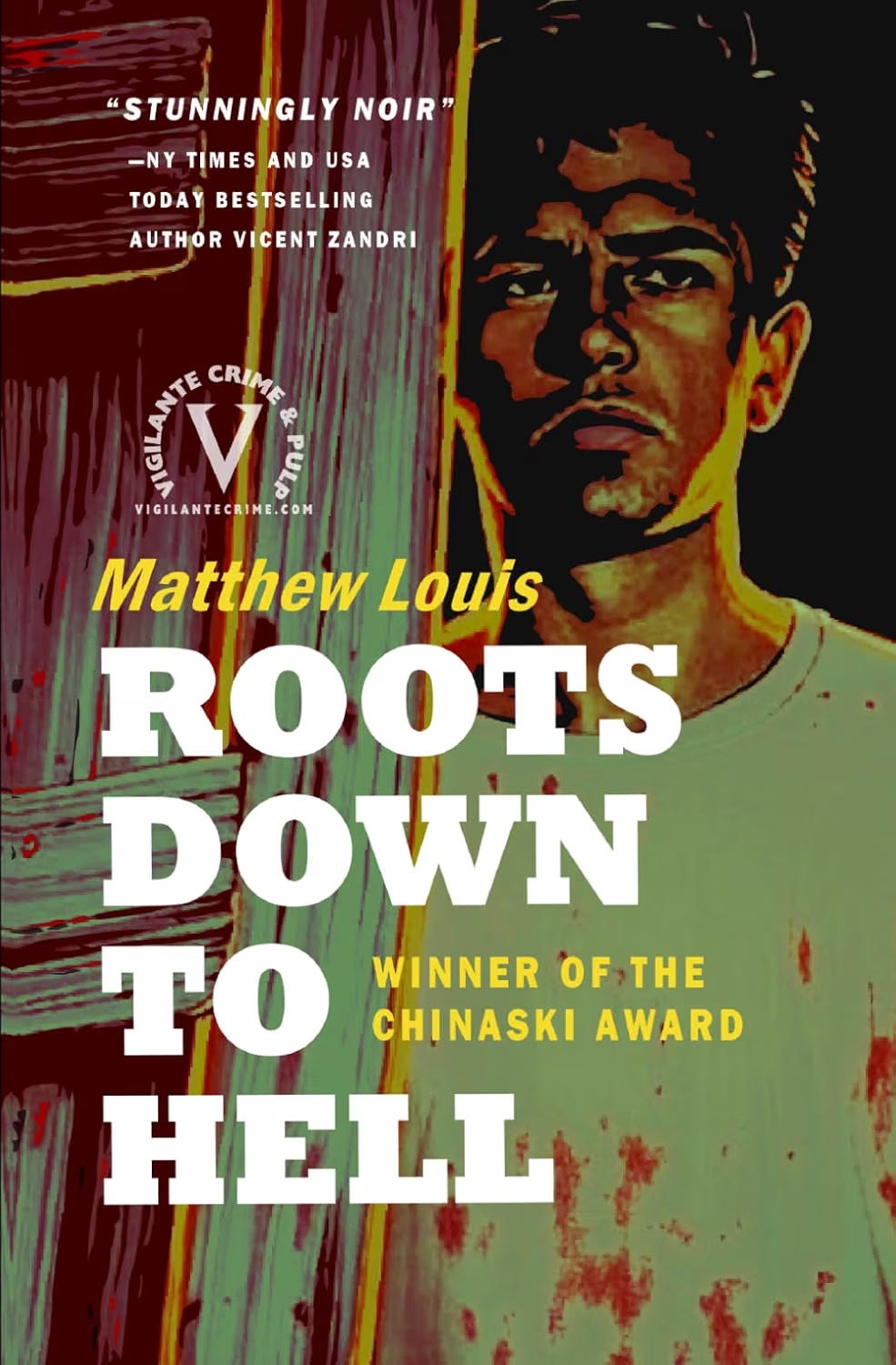
Matthew Louis’s Roots Down to Hell is not only noir, but it’s the blackest kind of noir—an obsidian look at the bloody heart of lower-tier America, with the warts not only exposed but highlighted. This novel, which was originally published 2023 and won the Chinaski Award for its close approximation to the spirit of Charles Bukowski’s boozy nihilism, starts like Hagler-Hearns and doesn’t ever let up. Like Louis’s other novel, The Wrong Man (also available from Vigilante Crime & Pulp), Roots Down to Hell focuses on a working-class loser trying to make good. Then, as in all good noir stories, fate intervenes and turns an already overcast world into absolute pitch.
Roots Down to Hell is about Kevin Chapman. And who is Kevin Chapman? Old Kev is a thirtysomething sheetrock monkey who is a recovered incel. Prior to landing his steady, blue-collar gig, Kevin was the lonesome son of a single mother with fake, plastic tits and a perverse deserve to hang on to youth at any cost. For years (possibly a decade), Kevin lived by himself in his room. He had the cold comfort of blue-filtered light for a while until a suicide attempt made his momma nix that idea and toss the computer out. Then, after discovering the pleasures of the public library, Kevin developed an addiction to American crime fiction. You know, the good stuff: Chandler, Hammett, Thompson, etc. This helped our hapless hero pull himself out of self-imposed exile, but what really did the trick was his uncle Cliff. Cliff is a beer-drinkin’, skirt-chasin’ sonofagun who, with the liberal application of the word “faggot,” guided Kevin towards the necessary waters of responsible manhood. Thereafter, Kevin popped his cherry at thirty with Michelle, his brand-new wife.
Kevin should have been set for life, but he’s not. A “bull dyke” lesbian with delusions of criminality named Sabrina interrupts his happy home. You see, while Kevin was busting his hump hanging sheetrock, Michelle went back to school and got a head full of nonsense. Every class about “white supremacy,” the “patriarchy,” and “intersectional oppression” helped to convince Michelle, herself a recovering social maledict, that her husband was an unrepentant fascist.
And fascists don’t deserve love or wives, folx.
So, in the novel’s opening chapter, Michelle decides to leave Kevin and take the cat with her. This naturally causes an argument, which in turns reveals not only Michelle’s unnatural acts with Sabrina (“Sabs” as she calls her), but also the gut-wrenching fact that Michelle aborted Kevin’s child without telling him that she was pregnant in the first place. Kevin does not take too kindly to this. Michelle finds a carving knife from the kitchen and jabs her husband in the shoulder. Kevin, in turn, grabs his grandma’s maple rolling pin.
After the cruel fury of seconds, Kevin has a dead wife on his hands.
Roots Down to Hell continues its machine gun pace after this opening action. Kevin puts his deep reading of hard-boiled and noir novels to good use as he attempts to cover his tracks. This endeavor has many obstacles: his mother lives next door in a trailer, Sabrina shows up asking questions, Michelle’s rabidly anti-Trump mom is used to daily texts from her baby, Sabrina has a junkie, homeless brother with an expert’s knowledge of the local busing system, and, at the halfway point, a pair of private investigators are hired after the local cops admit that they don’t have any evidence against Kev.
And Kevin still has to go to work too. Imagine sweating at the jobsite for eight to twelve hours after spending all night deconstructing your victim(s) hot automobiles? Oh, and don’t forget about the drugs. Kevin learns to his great dismay that Sabs’s boss bitch act wasn’t all pantomime. His wife’s lover really pushed product. Think baggies of white and blue powder. The hard stuff.
The main plotline of Roots Down to Hell is nothing novel. Louis is as much of an aficionado of noir as the fictional Kevin, and his slim novel is reminiscent of the more desperate yarns of Thompson, David Goodis, and the criminally overlooked Dan J. Marlowe. Kevin’s hyper-paranoia, his tense, all-consuming attempts to escape fate via manipulations and sweat are very much in the classic noir vein. Similarly, the milieu that Louis presents—the sleazy side of an Oregon small town—has its predecessors, especially in the post-World War II era of noir, when grimscribes like Fredric Brown refused to let a victorious and content America believe that badness only happened in cities.
Where Roots Down to Hell truly shines is in its unflinching portrayal of proletarian Americans. Kevin Chapman is not an exaggerated portrait. There are MILLIONS of lost boys in America who have made fathers out of the internet. Conversely, the wannabe radicals Michelle and Sabrina can be found in any downscale area, especially rural areas or college towns. My two favorite side characters, Isaiah and September, are equally true-to-life. Isaiah, who is Sabrina’s half-brother, is a doped-up rounder who is always scheming; always trying to get the better of his fellow flophouse residents. As for September, the former party girl and crook turned conservative Christian because of loneliness-inspired insomnia and C.S. Lewis YouTube videos, she could be one of my exes. Roots Down to Hell exposes the bitter truth that although socio-political cancers are created and propagated by the over-educated, monied classes, it is the poor and working class who are the most fervent believers/biggest victims. It’s diner goth times a couple million. As someone who is both a member of this class and one of its biggest haters, Roots Down to Hell felt like cringing into a cracked mirror.
Matthew Louis deserves more recognition. Hell, I cannot think of a writer more in-tune with the true spirit of noir than Mr. Louis. For evidence, look no further than The Reading Wife’s review of this novel. The titular reviewer castigates Roots Down to Hell as “egregiously insulting” and “trash.”
Good.
Noir is supposed to be ugly, about ugly people, and about the uglier things that they do. In this regard, Roots Down to Hell is almost perfect, and better yet, I’ll wager that you will not predict the ending.
Great review of a gripping novel.
I wish I had spoken so eloquently about this book on the Tortuga Media podcast. Great review and writing style. Ashamed I hadn't subscribed sooner.