


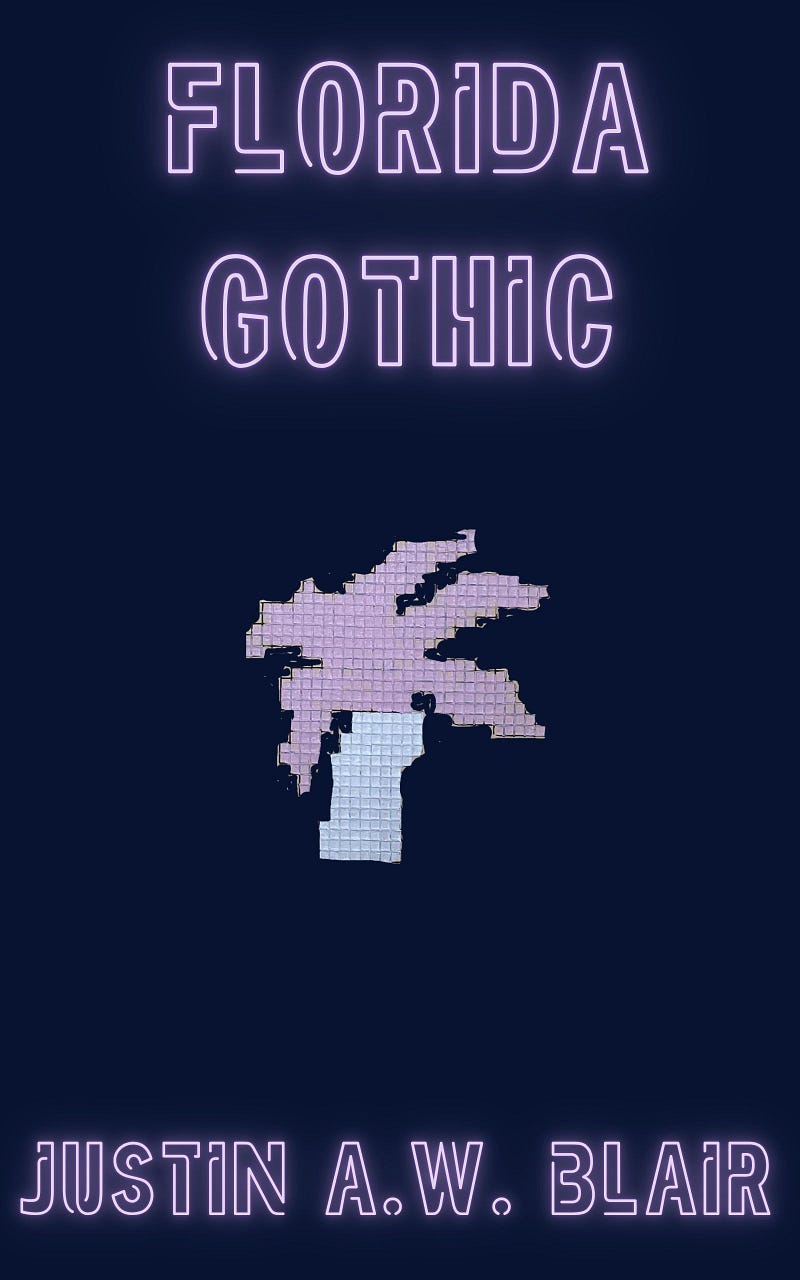
In case you don’t know, there’s this guy down in Florida. His name is Justin A.W. Blair. Not only does he have a YouTube channel for TRVE patricians only, but he is also a writer, painter, and documentary filmmaker. Readers of 1325 Publishing might remember Mr. Blair as the author of “Nemean Games,” which appears in Creepin’ Clues. Suffice it to say, Justin A.W. Blair is a Renaissance man standing outside of our hyper-specialized and ultimately boring epoch.
His latest work is entitled Florida Gothic. A collection of ten horror-ish tales set in the swampy heat of the Sunshine State, Florida Gothic is a marvelous addition to Blair’s growing oeuvre. The book predominantly features Blair’s Greyworlds universe, where Egyptian mummies, evangelical bounty hunters, psychic sasquatches, ghouls, gnomes, eldritch gods, and others live in an alternate version of Tarpon Springs right beside Mundaners (aka, the rest of us). In these tales, Blair weaves his own mythology and lovingly creates a cast of characters who are simultaneously ridiculous and tender.
There are standalone tales in Florida Gothic too. However, even in these nominally singular stories, connections exist, whether thematic or mostly just vibes. For starters, as the title says, everything takes place in Florida. Also, Mr. Blair has a special taste for using “losers”—thirtysomething pizza delivery drivers, underemployed wastrels, literal bums—as his protagonists, and these folks are almost always 1) smoking 2) drinking coffee and 3) complaining about the heat. There is also the element of night work; in the Greyworlds and out, Blair’s characters are creatures of the evening who do their business between sunset and sunrise.

Of the Greyworlds stories, “Nemean Games” is the best and the longest. It has the most characters, including the wonderful Ingo, a pot-smoking yoga enthusiast who is also a psychic sasquatch, and it fills in a lot of information missing from the other Greyworlds yarns collected here. As such, my first complaint with Florida Gothic is that it starts with the wrong Greyworlds story. “Nemean Games” is a better opener than “Bird People,” if for no other reason than that it better elucidates the structure and key figures of the Greyworlds. In “Nemean Games,” we learn about a pseudo-crime syndicate called The Conglomerate, feared and respected by the night creatures of alt Florida, and that Genseric is its mysterious leader. There is also the Gaunt Man, a fixer for our narrator, who is also good friends with Ingo and Chonso, an ancient mummy who works as the hearse/limo driver for Genseric. Finally, “Nemean Games” also discusses the importance of The Track to the Greyworlds, and underscores how dangerous the drug-fueled race is.
“Nemean Games” concerns a brutal crucifixion murder that is discovered in a former celery field that has been converted into a new land development site. Ingo has the straight skinny on the history of celery farming. At the same time, Billy Mizell, a Florida cracker cowboy who rides a bone stallion, speaks enough Koine Greek to figure out that the killers are long-forgotten deities from Hellenic paganism. “Nemean Games” is a wild, almost-surreal story with a hilariously mundane (get it?) explanation.
The second-best Greyworlds story in Florida Gothic is “Bird People.” Here, Billy Mizell is the star, and the setting is once again Tarpon Springs—the most Greek city in America. “Bird People” is a good, old-fashioned revenge story with a supernatural twist. Mizell and a Greyworlds-aligned homicide cop investigate the horrific murders of drug addict Kent Smith and his girlfriend Chelsea. The pair are found inside a bloody magical circle next to a rare book of spells. It does not take a genius to figure out that black magic is involved. When the big, bad magician is unmasked, he’s more pathetic than anything else—a representative of an older, Anglo-Celtic Florida who is displeased with one family member’s descent into criminality and drug abuse.
“Bird People” gets kudos in my book for the simple fact that it features a psychedelic gnome.
Another gem of a story, “Apocalyptic Wiggers in the Shadow of the Electric Beast,” uses somewhat low-brow humor to study the Greyworlds further. The titular Wiggers are a supernatural gang of goofballs who live near I-75. Genseric hires the narrator to help him negotiate with the Wiggers. This negotiation features a call-and-response rap ditty that loses steam faster than a decommissioned locomotive. A similar idiosyncratic humor appears in “Men Name Streets, God Names Graves.” The narrator in this repetitive story keeps bumping into Marduk-rat and his ever-shifting scent (headlights, shadows, the color purple, etc.)
“William Racer of Bone Valley, Florida” is less humorous, but it is arguably one of the more important Greyworlds stories in the collection. “William Racer of Bone Valley, Florida” provides a detailed summary of The Track and its effects on both participants and observers. For the creatures of the Greyworlds, The Track is their Las Vegas, Macau, Super Bowl, and World Series. For the beautiful journalist Angela Winterthorpe, The Track is the story that she needs to cover for financial and psychological reasons.
The best story in the whole shebang is “New Ownership.” A non-Greyworlds tale, “New Ownership” follows a hapless, suffering pizza delivery driver who wants the green mold removed from his apartment. This simple request proves hard to fulfill, as the prevaricating management sends double-talking agents to the man’s apartment to frustrate him rather than fix the problem. When more mold is found in another apartment, and people start chanting, the poor pizza man realizes that his problem isn’t mold at all.
For inexplicable reasons, “Doctor Gottili and Mr. Clark” reeks of Thomas Ligotti’s impenetrable gloom. Maybe it is the use of oddball names a la “Dr. Voke and Mr. Veech,” or maybe it is Blair’s injection of doom and malice into an otherwise pedestrian situation (a doctor’s appointment), but whatever the case, “Doctor Gottili and Mr. Clark” is more uncomfortable than it should be.
The weakest stories are “Annuit Coeptis” and “A Common Recurrence.” “Annuit Coeptis,” which Blair informs us in the Foreword was written way back in 2012, concerns the mental wanderings of a potentially schizophrenic homeless man named Carl. In “A Common Recurrence,” the narrator isn’t a bum, but he still works an odd job with odd hours and even less pay. His bête noire is his own garbage and the problem that someone or something is putting items into his trash without his consent. The biggest issue for our weirdo narrator is a shoe that he finds one day, and this shoe eventually worms its way until gold and human appendages are found. Like many stories in Florida Gothic, “A Common Recurrence” ends without a firm conclusion or many answers.
Florida Gothic is a fine collection of off-beat stories. The weird in this volume is not Lovecraftian (although “New Ownership” is vaguely Lovecraftian), but rather more “weird” in the general sense. Yes, there are monsters galore in this book, and that alone makes it worthy of inclusion in the horror genre, but Florida Gothic is neither gothic nor recognizably shuddersome. It is more Eerie, Indiana than The Twilight Zone. This book has coziness, heart, and good cheer. Florida Gothic is the opposite of nihilism and Cosmicism. It is, in a word, delightful—a strange trip through a ghastly, yet ultimately recognizable netherworld that exists amid the humid, flat fields of central Florida.
I have to disagree with you, my favorite story was definitely “Apocalyptic Wiggers in the Shadow of the Electric Beast." This is simply due to the fact that Ensign Blair does a great job of describing crackers from my county, Pasco County, where the wiggers tend to congregate. My barber is literally Big Bitch Moan, King of the Wiggers, he holds court every day in the barber shop he owns in Newport Richey.