

The Antifa Attack
A new short story by Andy Nowicki

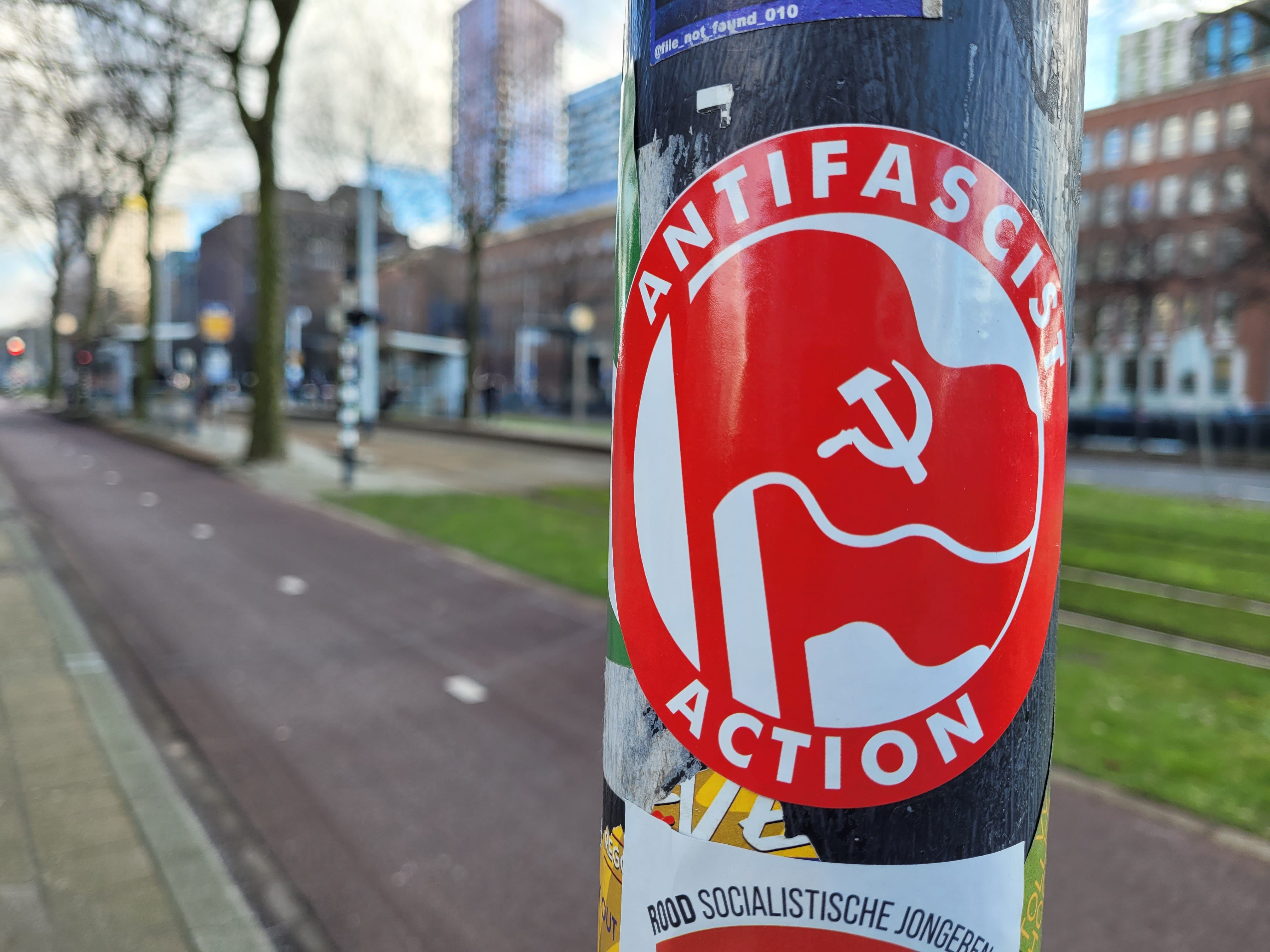
She recognized him immediately, the obscure dissident author, as she entered the downtown Atlanta restaurant. As if moved by some delicately wired inner programming, he looked up from his menu in her direction at exactly the moment when she was taking him in for the first time, and their eyes met.
Brittany smiled, then waved somewhat awkwardly; she endured a nearly debilitating rush of adrenaline as, seeing her, he stood and doffed his hat, adopting the manners of a gentleman in an old movie chivalrously observing the customs of a bygone day.
As she approached, he spoke first, muttering her name warmly. They shook hands, and she apologized for being late, since things at the conference had been so hectic.
“Are the antifa creeps doing their usual thing?” he asked as she sat across from him in a quite intimate booth in the back corner of the restaurant.
“They’re there, and all the blue- and green-haired girls, too. One of them called me a ‘Nazi whore,’ but I just smiled at her, sweet as can be, and said, doing my best imitation of a Southern belle, told her, ‘Bless your heart!’ Then she spat at me, but luckily I dodged it…”
“Nice reflexes!” he observed admiringly. She became even more aware of how tight the booth was in this crowded restaurant; it seemed, in fact, as if she were practically sitting in his lap.
“Do the police at least have them under control?” he asked.
“For the most part, yeah. It was just that one who went through, but after the spitting thing, they grabbed her and cuffed her… Then she began screaming at them, “All cops are bastards, all cops are bastards!”
“I’m glad they aren’t allowing those maniacs to run roughshod, as they did at Charlottesville,” he muttered. “That was truly insane.”
She recalled reading his account of that ill-fated event, nodded solemnly, and was about to say something when their waitress arrived to take their drink orders. He asked for a Coke, and she for a mocha latte. Once she left, he smirked, “White nationalist Barbie loves her gourmet coffee, eh!”
It was a reference to a satirical piece a hostile online venue had written about her a couple of years ago. She nodded, impressed with, and flattered by, his memory.
“A ‘Nazi’ obviously. How could I be otherwise? Attendee of a ‘trad wife’ conference. Married to a notorious Austrian nationalist.”
“Left your own country behind, you evil trollop,” he teased. Then his tone changed. “How does it feel to be back in your own country?”
“It’s been wonderful,” Brittany admitted. “Of course, Vienna is beautiful, but home will always be home. No matter how well I learn to speak German, in my soul I will always be an American.”
She found herself remembering the homecoming with her parents a few days ago, and began choking up a little, then felt temporarily mortified at having lost her composure in front of him. Sensing her distress, he reached out, touched her hand very delicately, then removed it again. His touch both calmed and slightly thrilled her.
“I can only imagine, of course,” he said. “I’ve got kids of my own, though they’re both grown, unlike yours. And even though I’m not with their mother anymore, there’s still a connection to them and to her and to the rest of my extended family. To have your husband and children in one place, and your ancestors in another…”
“The things you do for love,” she muttered.
“For love of your husband, for love of your children, for love of your people,” he stated. You’ve made a lot of sacrifices, my dear.”
There followed a moment of silence, in which it seemed that both interlocutors wished to say something, but neither could bring himself or herself to do so. As if by providential design, the waitress chose that moment to bring them their drinks and ask if they were ready to order. She opted for a Caesar salad, while he requested a braised chicken filet sandwich with chips.
She sighed.
“I haven’t told Gunther about our correspondence.” It sounded like a confession.
“Why not?” he asked.
She studied his face. This was the first time the two of them had actually laid eyes on one another. He was a good deal older than her. Though she didn’t know his exact age, she reckoned that he could have been anywhere from his late 40s to perhaps his mid-50s. Brittany, however, had just turned 32. A man his age ought to know what a woman meant when she dared to make such an admission to him. Yet his somewhat weathered face and deep-set green eyes betrayed only earnest inquisitiveness.
“I am loyal to my husband,” she said. “I will always be loyal to him.”
He nodded. “As you should be.”
There came another pregnant pause. Brittany sipped her coffee and said, “Your writings have had… an effect on me. For some reason, they make me feel… very seen. When I read your work, it seems to me that you are letting me know that…” She pondered, then ventured to continue. “I don’t know; your words make me feel that I’m not alone, I guess. Does that make any sense at all?”
He nodded. “Thank you, it’s very pleasing to hear that from you. I’ve been an admirer of yours for a while.”
Brittany felt herself blushing. His words seemed to caress her intimately, even as they stopped short of expressing anything untoward.
“I sent you that first email because I felt I just had to get in touch with you… I do read a lot, but in your case, I felt somehow summoned. It was like you were calling my name, even though, of course, you weren’t.”
“How did you even hear about me?” he asked. “I’m really quite a little-known author.”
He said this last with a self-deprecation bordering, she noticed, on bitterness. It was the first moment that he had tipped his hand, rendered himself vulnerable in a way, though she sensed such hadn’t been his intention.
“You are still very well known in certain circles,” she told him, trying to reassure him without coming across as patronizing. “Somehow I discovered you, and the rest is history.”
“The rest?” he asked.
“I am a changed woman,” she heard herself saying. Shut up, stop talking that way; you’re sounding like some kind of unhinged fangirl, she thought. Yet her mind was unable to restrain her tongue. “I don’t typically read material like yours. I don’t like bleak fiction about desperate people who do really bad things. But with your stories, it’s like you reach me where I almost don’t even want to be reached… You put things on display that I would rather not see… So you see, don’t you, how my husband might misunderstand my penchant for your fare?”
She pronounced “penchant” in the French manner; it was an affectation that she had developed since living in Europe, but she hoped it didn’t sound pretentious, or worse, like she was trying to be “sexy” or alluring to him. But nothing on his face registered any such apprehension. Instead, he looked thoughtful and maybe a bit confused.
“As I told you, it’s quite flattering to hear what you are telling me now,” he finally said. “And, not to be needlessly modest, but I would scarcely have thought of you as being within the demographic of my readership if I can be said to have one. As for your husband’s thoughts on the matter…”
Brittany was eager to hear how he would complete that sentence, but at that moment, something abruptly shifted in the general atmosphere of the restaurant. The author’s face suddenly looked past her with vigilant alertness, and the noisy din that had buzzed around them over the last few minutes, causing each of them to have to speak loudly to be heard by the other, in spite of the proximity of their bodies in this tiny booth, at once ceased. An ominous hush took hold in its place, peppered by a smattering of astonished gasps.
“Get down,” he emphatically urged her, and instantly, as if expecting this moment, she ducked her head and leaped under the table, just in time to hear a voice scream out, “Hey, fascist cunt!”
There followed a high-pitched scream and the sickening sound of a massive bodily collision. The gasps in the room had turned to cries and screams of alarm. The author’s voice was now saying, with an untrammeled fierceness, “Had enough, you fucker? Had enough?” She dared to look up and saw that a young person of indeterminate gender was being forcibly restrained by her lunch companion, who had shaken a bladed weapon out of the attacker’s hand. The dagger, long and serrated, lay on the floor while the attacker squirmed and thrashed under the author’s grip.
His face (she saw now that it was a man, or at least a biological male, though he wore rouge and lipstick) was bright red and engorged with murderous rage; he was flailing and his spittle-flecked lips screamed barely discernible vulgarities at the author who, with some effort, held him pinned to the floor. Presently, two other men rushed to help him restrain the still viciously resistant supine individual, who was now uttering disgusting blasphemies in an oddly guttural voice that barely even sounded human.
Brittany found herself reseated in the booth, staring with numbed shock at the flailing, babbling man being held down determinedly by two men, one of whom was hollering for the police to be called. She saw the author, her lunch companion, now freed from his task of restraining the lunatic, stagger back slightly, take the attacker’s discarded weapon in hand, and examine it, somewhat dazedly. He held it up to her, and she could discern a “trans” pride flag emblazoned on its hilt.
Later, the police arrived and forcibly dragged away the assailant, who kept bawling out a peroration that could only occasionally be understood. During semi-lucid moments, he boasted of how he “couldn’t be stopped,” and declared that “every last one of you Nazis, from Charlie Kirk on down, will die in a sea of blood; my comrades and I will see to that!” Then he lapsed into some strange alien or infernal tongue that none could possibly decode, nor wish to, in that same disconcertingly inhuman guttural voice.
A policeman spoke to the two of them to get their witness accounts. Brittany told him the truth: that she had seen nothing prior to her lunch companion telling her to duck, then hearing the resultant melee play out, which crouched furtively beneath the table.
The author told the cop that he saw the young man enter the restaurant, recognized that he looked like some kind of “antifa” type of character by his manner of dress: militant T-shirt depicting a burning swastika flag, under the heading PUNCH A NAZI FOR SATAN TODAY!, along with a “pride” lapel sewn onto one sleeve and the phrase “NERF TERFS” emblazoned on the other. In addition, a surgical face mask had been strapped across his mouth and nose, effectively covering his face.
Then he saw the same man, his mask now pulled down, making a beeline towards their booth, attempting to be stealthy but utterly failing, in part because he was somewhat rotund and moved clumsily, and in part because he was holding something behind his back in his right hand, which the author was sure must be a weapon.
It was at that moment, he told the policeman, that instinct kicked in. He instructed Brittany to duck and rise to confront the attacker, who, after seeing him take to his feet, “screamed a kind of absurd war whoop,” and lengthening his stride, was soon upon him, brandishing what had been revealed as a wickedly long knife.
“Clearly, Brittany was his target, and I was in his way,” he said.
The author had absolutely no experience with fighting, but something told him to go low, so he dove hard at the attacker’s knees, which caused him to lose his balance; however, the man, with his considerable girth, then toppled awkwardly on top of him. After a scuffle on the floor, the author managed, with some struggle, to gain the upper hand (the attacker was fat but not particularly strong or nimble), whereupon he pinned the assailant down and straddled him—the force of the young man’s fall had knocked the weapon out of his hands and caused it to skip out of his reach.
“I tried to keep him down, but he kept fighting my grip, and looking into his contorted face as he hollered absolutely hateful things up at me, and kept trying to push away from me with his weighty frame, so by the time those two other guys ran over to help, I was totally exhausted,” he said. Then he showed the policeman the dagger with the “trans” insignia, which was promptly confiscated for evidence.
Neither Brittany nor the author found himself terribly hungry after enduring this unforeseen ordeal, so both of them took their meals to go, and left the restaurant in a kind of daze.
Neither spoke for a time; they just walked together. Fortuitously, the restaurant where they’d met was at the edge of a small park, where soon a bench stood under the afternoon shade provided by two newly-blooming dogwood trees growing side by side.
They sat, as if by commonly reached accord, though neither had spoken a word.
“Well… welcome to Atlanta,” he said, after a long moment, in an effort at a witticism to lighten the mood. Brittany managed a smile and shook her head ruefully.
“That guy was honestly trying to kill me, wasn’t he?” she asked, still bewildered.
“I wouldn’t ‘assume his gender’… but yeah.”
“You don’t possibly have a cigarette on you, do you?”
“I’m sorry, I don’t smoke.”
“I don’t either, not for almost ten years… but if ever there were a day to relapse…”
They sat again in silence for a long moment. Brittany had never been to the South in springtime before, and the cool, temperate day, spiced by a scent of magnolias carried in a cool gust of wind, brought a welcome, soothing balm to her frazzled nerves.
“I should say thank you for saving my life. So, thank you,” she told him earnestly.
“Ah, don’t mention it. That fat tranny nearly took me out, too…”
Then she became somber again.
“It’s getting worse, isn’t it? I mean, me? I’m not even that well-known. And I’ve been trying to keep a lower profile lately…”
“Hey, you and I were both on the ‘ADL’s most naughty people’ list, remember? But I guess I’m a bit less famous, and certainly less photogenic.”
She shook her head, attempting, unsuccessfully, to ward off tears.
“I feel so helpless,” she said. “I don’t like to be that way. I just want to be a good wife and a good mother. I thought I had retired from being a media personality. But my past follows me wherever I go, it seems.”
“Those people, our enemies, they hold grudges. They don’t forget,” he pronounced. “We knew the deal when we walked into this fight. We knew what the stakes were. I’m afraid there’s no ‘retirement’ possible.”
“Not until we reach our eternal reward,” Brittany answered.
“You’re still young; you’ve got a lot of life to live,” he told her. “Don’t let these maniacs deter you. The cause for which you fight is correct, good, and proper. Go back to your new home, live rightly, and trust God. He works in his own time, as I’m sure you know, and all things ultimately are drawn into accord with his will. It’s an inevitability. Looked at a certain way, it’s already happened. We would be able to see that if we could see as God sees, and as the saints see, from the perspective of Heaven.”
At the same time that she heard his words of encouragement, Brittany realized that she was simultaneously speaking them to herself from within the depths of her own soul. It was a rare and extraordinary moment, one in which two minds apprehend identical thoughts together, in unison, something like a shared telepathy, together with the mind of the Divine.
The fragrant Dixie wind gusted again, sending the dark locks of Brittany’s hair scattering into her face. The wind bloweth where it listeth, she recited to herself, eyes closed.
Then she felt a warm hand gently resetting her tresses, tucking them behind her ears. She opened her eyes and gazed into his. This time, oddly enough, they appeared to be azure blue; she could have sworn earlier, when she scrutinized his face in the little booth of that restaurant, that his eyes had then shown themselves to be emerald green.
“Ready?” he asked, touching her cheek tenderly, sopping up the little tears that she had wept.
She nodded. They rose in unison and walked together: out of the little bucolic patch of the city park, back onto the streets of Atlanta, toward the downtown hotel that was hosting her conference.
Brittany now felt remarkably calm. She knew that the peace of mind which now pleasantly engulfed her wouldn’t last forever, yet she also sensed, with something close to certainty, that her spirit would be sustained in the years to come, through numerous tribulations, so long as she remained faithful.
The pair paused before the entrance to the venue. The sidewalk traffic had thinned out; the very air seemed to wait expectantly as the “trad wife” influencer and the obscure dissident author faced one another a final time.
“You’ll be in my prayers every day,” she told him, with marked conviction.
“And you’ll be in mine,” he answered, matching the fervor of her tone.
They embraced for the briefest of moments, just long enough for Brittany to feel the sinews of his chest, a sensation that made her recall her father. Then she turned and entered the swinging door hotel, leaving him behind.
She turned around to wave at him one last time, but saw that he was already walking briskly away, planting his hat back onto his bare head and not looking back.