


This article was originally written for FIRST THINGS. It got rejected this week. Frankly speaking, I get so many rejections that they all bleed together. However, I kind of like this one.
In the Anglophone world, there has always been a peculiar overlap between Catholicism and crime fiction. The two great inventors of the American style of mystery fiction—the hard-boiled detective story and the roman noir (the literary precursor to film noir)—Dashiell Hammett and James M. Cain, were both baptized and raised in the faith before ultimately rejecting it as adults. Hammett became a Pinkerton then a Marxist, dedicating himself to full-time activism in the 1930s, and ultimately earning himself a conviction for violating the Smith Act. Cain, on the other hand, adhered to strict atheism, labelling his family’s creed as “mumbo-jumbo.”
Across the pond, where the “cozy” style of mystery writing predominated, Catholic converts like Ronald Knox and G.K. Chesterton penned novels and short stories of a less violent, more cerebral variety than their American cousins. Chesterton famously even made a priest, the veritable Father Brown, as his own Sherlock Holmes.
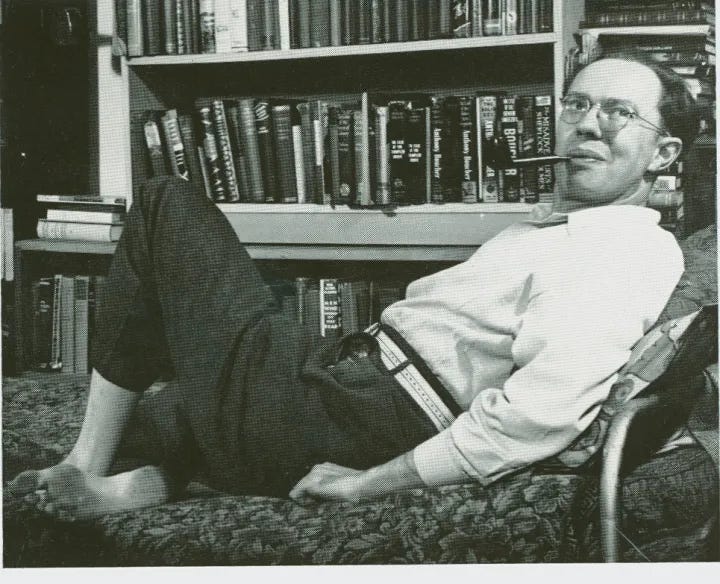
The heyday of crime and detective fiction, roughly the twenty-year stretch between the two world wars, had a lot of turncoats, I.e., British authors like James Hadley Chase who wrote tough, bloody thrillers, and Americans such as John Dickson Carr who became popular for their elaborate, puzzle-like locked room mysteries set amidst the bucolic splendor of rural England. Enter Anthony Boucher. Born on August 21, 1911, Boucher came kicking and screaming into the world as William Anthony Parker White. He was born, reared, and would ultimately die in Oakland, California on April 29, 1968. Between those years, Boucher made himself into the doyen and dean of speculative letters, as everything from an editor to an anthologist and book reviewer. From the latter perch, where Boucher reviewed mystery, science fiction, and horror novels for the San Francisco Chronicle, New York Times, and Ellery Queen Mystery Magazine, he proposed a Code of Ethics for reviewers of mystery novels that put the reader—their enjoyment and interest—front and center:
I shall try to remember that while the critic writes for The Ages, the first duty of the reviewer is to help the prospective reader to decide whether or not he’ll enjoy the book in question.
Among the extremely diverse books lumped together as “mysteries,” I shall try to judge each fairly according to the best standards of the type which the author intended to produce, and not those of another type which I personally prefer.
I shall never interfere with the reader’s suspense and enjoyment by revealing the solution, or any other element which the author deliberately and for good reasons withholds from the reader for a major part of the book.
Boucher’s strong suit was mystery fiction, of this there is no doubt, but in his capacity as a reviewer, editor, and anthologist, he championed the work of authors such as Robert Bloch, the author of Psycho who toiled for years in the weird horror and science fiction pulps before breaking into the mainstream; Shirley Jackson, the tortured genius behind “The Lottery” and The Haunting of Hill House; Charles Beaumont, the doomed short story specialist who penned some of the best scripts for The Twilight Zone; and Philip K. Dick, author of the novel that would later become Blade Runner.
Boucher’s connections to speculative fiction ran deep in other directions as well. Indeed, Boucher is considered one of the godfathers of science fiction. Boucher’s first professional story, 1941’s “Snulbug,” was purchased by Unknown magazine, one of the trailblazing publications of sci-fi’s Golden Age. From then until 1955, Boucher’s literary output was almost exclusively science fiction and fantasy. In 1949, he and author J. Francis McComas founded The Magazine of Fantasy & Science Fiction, and following McComas’s early departure in 1954, Boucher edited the magazine alone for four years. F&SF is still going strong today, and its sterling reputation is the result of Boucher’s gentle, guiding hand—the same hand that first serialized A Canticle for Leibowitz, Walter M. Miller, Jr.’s post-apocalyptic sci-fi novel about a small group of Catholic monks in the American Southwest who preserve the remaining remnants of humanity’s theological, cultural, and scientific knowledge in preparation for the civilization to come. A Canticle for Leibowitz earned a much-coveted Hugo Award for Best Novel in 1961, thus adding, however partially, to Boucher’s two Hugo Awards for Best Professional Magazine (F&SF) in 1957 and 1958.
Boucher’s editorial and critical work are rightfully remembered and praised. The annual Bouchercon World Mystery Convention, which started two years after Boucher’s death in 1970, celebrates the best in mystery, suspense, and crime fiction every year, just as Boucher once did with his many newspaper and journal bylines. Bouchercon serves as a reminder not only of their namesake’s contribution to mystery fiction, but also to the fact that critics, book reviewers, and those who work behind the scenes play a vital role in the production and dissemination of culture.
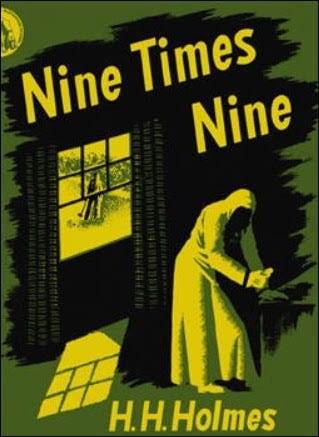
However, Boucher did more than review mystery novels; he wrote them too. Three of them—1940’s The Case of the Baker Street Irregulars, 1940’s Nine Times Nine, and 1942’s Rocket to the Morgue—are considered classics of the locked room style of mystery fiction (a style wherein someone dies in a locked or otherwise sealed room). Nine Times Nine earned the distinction as being ranked as the ninth-best locked room mystery of all time by other mystery writers in 1981. Nine Times Nine and Rocket to the Morgue are also the only two entries in Boucher’s Sister Ursula series, where the devout Sister Ursula, a nun with the fictitious Order of Martha of Bethany, uses her insights into the human soul to help solve two seemingly impossible crimes.
Nine Times Nine is set in the milieu of alternative religions and their critics in prewar Los Angeles. A yellow-robed charlatan who calls himself Ahasver leads the Children of Light, a cult that believes that the Bible is a lie, and that only the esoteric Gospel of Joseph of Arimathea is true. Ahasver, who claims to the be the Wandering Jew of ancient Christian folklore, tells his multi-ethnic congregation that he found the fabled Gospel of Joseph of Arimathea in a Tibetan monastery. The Children of Light believe that Jesus was not crucified until the Friday following Passover, thus rendering the traditional celebration of Easter Sunday null and void.
Ahasver’s chief nemesis in Los Angeles is Wolfe Harrigan, a celebrated writer who made his fortune debunking mysticism and the claims of international cults. When Matt Duncan, Harrigan’s personal secretary, sees a strange figure in a yellow robe in the writer’s study just before he is found dead, the supposition is that Ahasver is involved in the murder. After all, the faux holy man has already cursed Harrigan with the threat of the “nine times nine.” Sister Ursula is not so sure and working alongside LAPD Lieutenant Terrence “Terry” Marshall, she helps to prove that the death of Wolfe Harrigan was something other than an occult sacrifice.
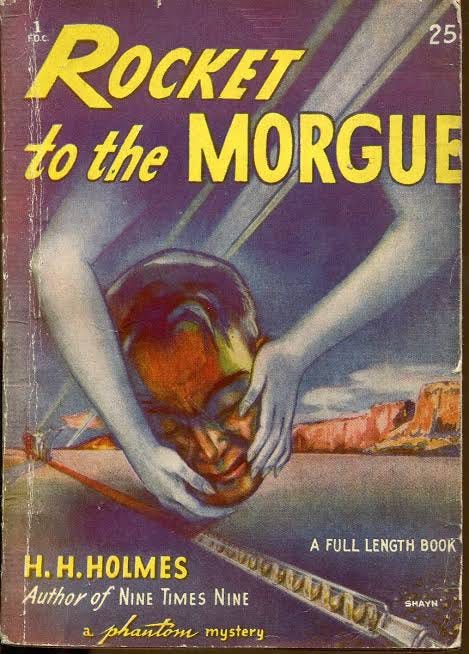
Rocket to the Morgue picks up not long after the events of Nine Times Nine. Here the milieu is the world of science fiction writing and its fandom. Hilary Foulkes, the son of the dead sci-fi author Fowler Foulkes, creator of the popular Dr. Derringer character, is not well liked by other authors in the Los Angeles scene. His possessiveness of his father’s legacy, plus his predilection for bankrupting science fiction authors, means that Terry Marshall is not surprised when he is assigned to the Hilary Foulkes case. You see, Hilary and his estranged wife are convinced that someone is trying to kill him. There’s plenty of proof too, including not just harassing phone calls, but also a ticking parcel that was mailed to the Foulkes residence. All of this occurs against the backdrop of another crime that occurs down in the gutter of L.A.’s Skid Row. Here, a drifter with a room at a fleabag hotel is found dead clutching a most peculiar kind of rosary. Once again, all these events coalesce into a singular narrative—a narrative that includes a spectacular explosion of an experimental rocket witnessed by science fiction writers who are thinly-veiled caricatures of legends like Robert A. Heinlein, Jack Parsons, and Jack Williamson among others.
As with Nine Times Nine, the appeal of Rocket to the Morgue is twofold: its complex, engaging mystery and the homey, quaint atmosphere that pours forth from every page. Boucher, despite frequently using the name of a vicious American serial killer for a pseudonym, was a master at an American version of the cozy mystery. And, with a nod to Chesterton’s Father Brown series, Boucher’s two great locked room mystery novels are thoroughly Catholic in outlook, ambience, and belief. Nine Times Nine takes place during Lent, and almost every single character in the novel is a serious Catholic, even including Wolfe Harrigan, who publicly claims that his debunking is tied to his support for Roman orthodoxy. Then there’s Sister Ursula herself. Not only is she depicted as a brilliant investigator, whose intelligence and insights come courtesy of her voracious reading of popular fiction and the Bible, but even the earthy Terry Marshall has connections to the church via his wife, the devout Leona, whom Terry meets first in Nine Times Nine. In these novels, someone is always praying, fasting, or fretting about whether they can receive communion that Sunday.
This Catholicism, along with the presence of happily married families with children, separates Boucher from his American contemporaries, who predominately wrote dark, fatalistic crime stories about amoral crooks, femme fatales, and crooked cops. Boucher’s literary universe is moral, and his detective fiction follows the rules of decorum and fair play. Boucher managed to do all of this without slipping into naked Anglophilia. Sister Ursula, Terry Marshall, and Leona still live and work in pre-World War II L.A., they listen to the radio and read the newspapers. When they speak to each other, they speak in the rapid-fire dialect of the United States. As such, Boucher’s Sister Ursula novels, along with his other detective fiction outings, are the perfect reading material for those who want a warm and friendly murder story without it being either overly saccharine or enmeshed in a far-off world of landed nobles and country estates. Plus, a Boucher mystery may teach you a thing or two about faith.
I remember when I used to submit things to First Things. Gave up on that racket a long time ago, you're evidently more resilient than me!