

The Many Notes from the Underground
A (Thoughtful) Review of "Carbon Pages" by Daniel Gaviloski

Earlier this year, ferret-faced thespian Timothée Chalamet ruffled more than a few feathers by disparaging opera and ballet as “dying” and “unpopular” art forms that require massive subsidies from wealthy patrons and civil governments because general audiences don’t care about them anymore. The unspoken addendum to this assertion, that film, which is Chalamet’s medium of choice, retains mass appeal and importance, is questionable. Cinema is dying, but at a slower rate than ballet or opera.
Reactions to Chalamet’s assertions were swift and, frankly, petulant. The Seattle Opera even used the actor’s name as a discount code for their tickets. Take that, Frenchie, I guess.
Anyway…
Discussing this simple brouhaha calls to mind another dying art form: the stage. Broadway ain’t much anymore, and one gets the feeling that the stage only exists so that movie and TV actors can do a “side quest” or two in order to add gravitas to their limp resumes. And then there are playwrights. Who is the most famous, most widely read playwright living right now? Beats me. Do you have an answer? Doubtful. Given this reality, any writer specializing in plays unlikely to be staged or produced must be a madman of some sort.
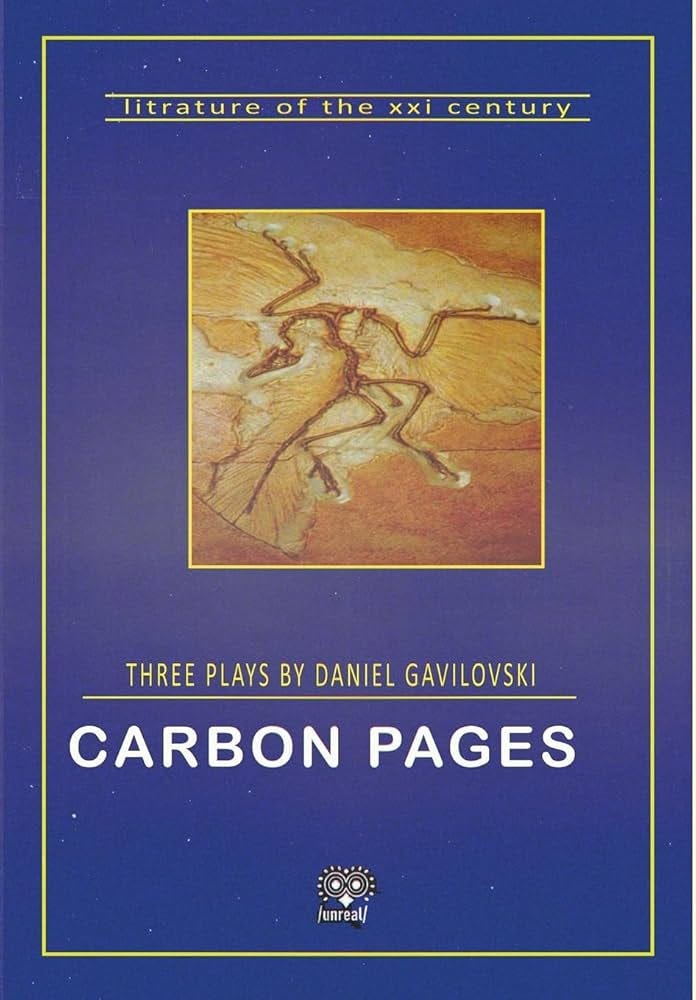
Enter Daniel Gaviloski, one of the central figures of Unreal Press, THE publisher of lit/ ficiton. A Hiberno-Russian author based in the Russian-majority city of Daugavpils, Latvia, Gaviloski’s debut effort is a collection of three plays entitled Carbon Pages. According to the author’s preface, the book’s title is a reference to the dissident, self-published samizdat of the Soviet period. Carbon Pages is therefore an intentional stirring from the literary underground—an unrepressed return from the chthonic depths of tarnished European high culture. And Carbon Pages definitely aims for high culture: the three plays contained in this collection (two of which the author informs us have been staged in Munich and Dublin) are high-brow experimental, sometimes crass but always in an erudite way, and bear all the morbid oddity of Bruno Schulz and Sigizmund Krzhizhanovsky. Indeed, the thoroughly Eastern European (specifically Russian) quality of this work gives it a certain heft of Slavic seriousness à la Mikhail Bulgakov and the inaccessible comedies of Mikhail Zoshchenko. As a complete work, Carbon Pages delights in the anarchic absurdity that so often travels right beside pretentious artists as they attempt to translate the life of the mind into life as it is actually lived.
The opening play, stylized as “COGNITOHAZARD,” is my favorite in the collection. Here, time and place seem settled until they don’t. We are told that the story takes place in an Italian bordello “after the war.” We are not told which war, but usually, when “postwar” is invoked in the context of Europe, it is a given that the war in question is World War II. However, in “COGNITOHAZARD,” the babbling whores speak in circles while Plastic Bertrand plays on the radio. That should at least place things in the late ‘70s, yet nobody refers to the 1970s as “postwar,” even if it’s technically correct. There are other moments in this place that similarly confound temporality, which is kind of the point.
“COGNITOHAZARD” has as its characters a bunch of loquacious prostitutes—Lola, Krystal, Topaz, and Madame Mandelstam. These characters are indistinguishable from one another, although Miss Mandelstam does wind up murdered in the bordello’s sitting room. Only one hooker, Chichi, is memorable, and that is because she is mute. Chichi also seems to be the only prostitute with any sense, for as events begin to unravel in the bordello, it is only Chichi who takes things seriously. The menace stalking the prostitutes is not just the killer of Miss Mandelstam but is also the great mind-eraser squatting in the bathroom. You see, whenever one of the girls works up the gumption to go and look at the killer lurking near the sink, she returns to the adjoining room with a major case of amnesia. Even the with-it Chichi is left scribbling blanks after spending mere seconds in the bathroom.
Gaviloski makes the brilliant decision to let his monster loose without describing it. At the play’s climax, as the whores bicker over the usual drama, the Lovecraftian monstrosity leaves the bathroom and slinks around menacingly until one of the girls basically tells the stygian horror to leave them all alone. They’re busy being bitchy to one another, after all. The unnamable horror attacks, nevertheless, and “COGNITOHAZARD” ends with all of the prostitutes leaving the room as if nothing happened at all.
While “COGNITOHAZARD” is a stupendously trippy horror that defies genre conventions, the final play in the collection, “Boring and Broke in Buenos Aires,” is more standard fare. The Buenos Aires of this play reads like the Digital Age’s answer to Jazz Age Paris, where artists as illustrious as Gertrude Stein, F. Scott Fitzgerald, and Ernest Hemingway flitted away hours discussing fiction and art in between endless rounds of coffee and cocktails. Here, underneath Gaviloski’s pen, we are introduced to an assortment of oddballs ranging from the British sci-fi writer Parker, who believes that writers must live (see: sleep with prostitutes and get drunk) in order to write anything worth reading, to the cerebral French Maoist Marquis, who always speaks as if he’s giving an oration on philosophy. Other characters come and go, but really, none of them are important. What matters more is the mise-en-scène of the digital nomads in Buenos Aires and their meandering discussions about creativity, marketing, and artistic productivity. One gets the feel of being a ghost seated next to these blowhards as they speak in an Internet-meme argot between highfalutin dispositions. The only character who gets close to the truth is the foul-mouthed Melman, who shits all over the idea of writing in the twenty-first century.
Artist, writer. It’s all pointless. There’s nothing to write about no more. Everyone has the same boring life, man. The same blue screen childhood followed by 8 hours of school. That’s your early twenties right there. Then wageslave till you die leap frogging from Netflix show to videogame.
Like any good truthteller, Melman eventually loses his train of thought and gets drunk. “Boring and Broke in Buenos Aires” ends with nothing happening, which is a succinct summation of the contemporary vagabond existence of “artsy” expats.
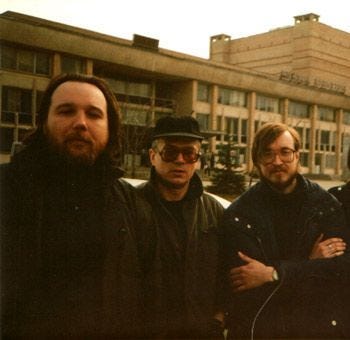
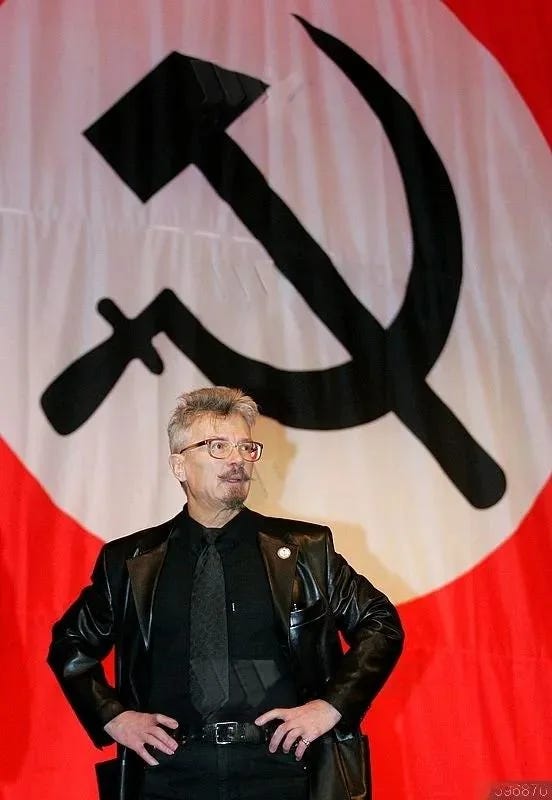
Gaviloski’s undisputed magnum opus is the collection’s second play, “No Weapon Formed Against You.” This epic spans over two hundred pages and contains three sections set in 1980, 1993, and 1999. The author admits that this play may forever elude staging attempts due to its sprawling nature. “No Weapon Formed Against You” recounts the origins of three Russian artists and intellectuals—the poet and novelist Eduard Limonov, the academic and political theorist Aleksandr Dugin, and the musician Yegor Letov. In the first section, Dugin and Letov are shown to be social dissidents who are institutionalized and interrogated by the Soviet Union’s security and medical bureaucracies. Both men are accused of publishing samizdat and smuggling in such offensive contraband as Beatles and Rolling Stones records from the West. Limonov, on the other hand, is living down and out in Paris as a literary wunderkind with a wealthy French lover and a supportive editor at L’Idiot. Limonov lives in exile in the West, where he cultivates a punk persona while earnestly being enchanted by all things French and American.
Cut to 1993. The Soviet Union has collapsed. All three men are now living in a democratic, capitalist Russia. One would think that they, the victims of late Soviet boorishness, would celebrate such an existence, but you would be wrong. Limonov, Dugin, and Letov publicly sing the praises of left- and right-wing authoritarians like Stalin, Hitler, and Gabriele D’Annunzio for their gallant stands against Anglo-Saxon civilization. Their mouthpiece becomes the National Bolshevik Party, a synthesis between Marxism-Leninism, Russian nationalism, and fascism. Dugin is drawn as the party’s great brain—a deeply religious man who nevertheless traffics in occult rituals that border on bourgeois Satanism. The popular Letov is the party’s manager—a surprisingly rational and hard-headed man despite his effusive declarations in support of individualist anarchism. Limonov is, in many ways, the same character from 1980, and his thirst for preening publicity makes him the figurehead of the insurgent NazBols.
The final section of the play, set in Moscow and Kazakhstan in 1999, sees Limov and Dugin lead a quixotic, Fiume-esque march on a Kazakh border town in the hopes of establishing an independent state dedicated to National Bolshevism. The occupation of Lapdukk draws in political radicals from as far afield as Italy, which in turn draws the ire of President Yeltsin back in Moscow. Ledov, now a member of Russia’s parliament, coordinates the peaceful return of Lapdukk to Kazakhstan and the dispersal of Limonov and Dugin’s militia, but ultimately an alternative timeline forms in which the National Bolsheviks seize power in Moscow and Limonov becomes the great hero of a new state. None of this happened in reality, of course. The real Limonov was suppressed and arrested by the Putin regime for supposedly planning a private military expedition in Central Asia, while Letov renounced all political activism before succumbing to a heart ailment at just forty-three. Dugin, of course, is often characterized as “Putin’s Rasputin” in the West, and he appears frequently on podcasts in order to denounce “Satanic” America [1]. Yet, according to many Russians, Dugin is treated as a minor curiosity in his home country. The truth about Dugin is probably somewhere in between. After all, you don’t murder the daughter of a “minor curiosity.” Dugin is clearly more important than that.
“No Weapon Formed Against You” shows off Gaviloski’s exceptional talent for dialogue. There is also a lot of genius black humor in this fictional rendering of recent history. Limonov in particular is a riot, if only because he is such an irredeemable prick. Of all the characters, Letov comes across best, but he is given the least stage time compared to his co-conspirators. Ultimately, this is a play that demands a basic knowledge of Russian history, literature, and politics. Being ignorant of all three doesn’t mean you cannot enjoy “No Weapon Formed Against You,” but it does mean you’ll be confused quite a bit.
Carbon Pages is exceptional and, at the same time, exceptionally weird. The many sketches contained within this work, which recall the art of Ralph Steadman, highlight the bone-deep weirdness like none other. These plays are not destined for Broadway, either on or off, and that is just fine. All three can be read and enjoyed as short stories told via dialogue, and that is fine too. Pretty much everything is fine about this collection, and while Gaviloski is definitely guilty of being too non-conformist too much, and while the Irish-Russian-Latvian playwright reads like a man impressed with his own intelligence, it is hard to argue that Carbon Pages is not one of the most outstanding pieces of capital L literature produced by the online dissident sphere. This book has the makings of a seminal text, and like many such testaments, it may take a while for the normies to recognize and appreciate its idiosyncratic artistry.
[1] Dugin’s most recent controversy stems from his Twitter account. Namely, Dugin wrote several missives denouncing White people and saying that White civilization ought to be terminated.
Move over, Neil Labute!